Read the following passage about the Climate-Induced Displacement: A Growing Global Crisis and mark the letter A, B, C or D on your answer sheet to indicate the best answer to each of the following questions from 31 to 40.
The contemporary climate catastrophe has emerged as an unprecedented humanitarian challenge, compelling millions to abandon their homelands permanently. According to UNHCR's comprehensive No Escape II report, climate-related disasters have displaced approximately 250 million individuals over the previous decade—equivalent to 70,000 daily displacements. [I] While vulnerable populations attempt to roll with the punches of intensifying environmental devastation, governments worldwide struggle to provide adequate assistance. This crisis exemplifies how climate change operates as a "risk multiplier," aggravating existing conflicts, food insecurity, and socioeconomic disparities across fragile regions globally.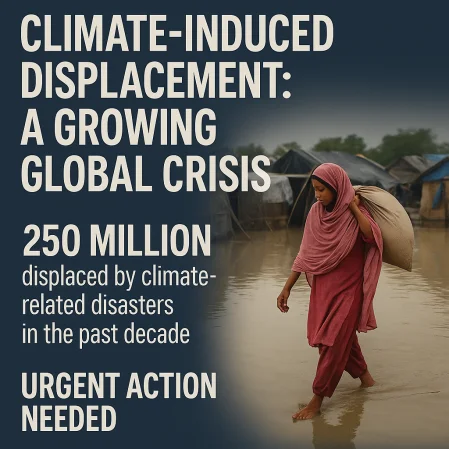
[II] Brazil's 2024 floods in Rio Grande do Sul killed 181 people and displaced 580,000, including 43,000 vulnerable refugees. Myanmar's Cyclone Mocha obliterated Rakhine State in 2023, completely demolishing shelters housing 160,000 Rohingya refugees. Chad experienced catastrophic flooding in 2024, compelling 1.3 million of its inhabitants to evacuate—surpassing displacement figures from the preceding fifteen years combined. These calamities demonstrate disproportionate impacts on marginalized communities that contribute negligibly to global emissions yet endure the severest consequences.
Currently, three-quarters of all refugees inhabit areas experiencing elevated climate-risk exposure, while half of displaced populations reside in politically unstable states, including Sudan, Syria, Haiti, and Yemen. The number of nations confronting both conflict- and disaster-related displacement has tripled since 2009. However, fragile countries hosting refugees receive merely 25 percent of the requisite climate financing, abandoning millions in perpetual crisis. [III] This insufficient funding severely undermines resilience-building initiatives and emergency response capabilities throughout affected regions.
Without immediate intervention, experts predict refugee settlements could endure 200 days of extreme heat annually by 2050, rendering them uninhabitable. UN High Commissioner Filippo Grandi emphasized at COP30 that vulnerable communities require substantial climate finance rather than hollow commitments. The international community must prioritize comprehensive strategies addressing both immediate humanitarian necessities and long-term adaptation measures to mitigate future displacement emergencies effectively. [IV]
https://www.theguardian.com/lk
Question 31: The phrase “roll with the punches” in paragraph 1 has the closest meaning to _________.
A. give up B. break down C. deal with D. run away
Question 32: All the following information is mentioned EXCEPT _________.
A. International cooperation has effectively reduced climate displacement in several regions
B. Chad's 2024 flooding displaced more people than the previous fifteen years combined
C. Marginalized communities contribute negligibly to global emissions yet suffer severe consequences
D. Fragile countries hosting refugees receive only 25 percent of the requisite climate financing
Question 33: The word “its” in paragraph 2 refers to _________.
A. The catastrophic flooding
B. Displacement figures
C. Climate-related disasters
D. Chad
Question 34: Where in the paragraph does the following sentence best fit?
Devastating recent incidents illustrate the magnitude of climate displacement effectively.
A. [I]
B. [II]
C. [III]
D. [IV]
Question 35: Which of the following best summarises paragraph 3?
A. Most refugees live in high-risk areas, but host countries receive insufficient climate financing, perpetuating crises.
B. Three-quarters of refugees inhabit unstable regions where emergency response systems have completely failed.
C. Climate financing reaches only 25% of fragile nations, tripling displacement rates since 2009.
D. Political instability and climate risks have overwhelmed resilience-building initiatives in affected countries.
Question 36: The word “requisite” in paragraph 3 is OPPOSITE in meaning to _________.
A. compulsory
B. vital
C. redundant
D. crucial
Question 37: Which of the following best paraphrases the underlined sentence in paragraph 4?
A. Grandi urged at COP30 for comprehensive financial support plus meaningful international commitments.
B. Grandi stressed at COP30 that vulnerable communities need real funding, not empty promises.
C. Grandi advocated at COP30 for immediate climate funding and robust emergency mechanisms.
D. Grandi demanded at COP30 enhanced resilience programs over inadequate government pledges.
Question 38: Which of the following is TRUE according to the passage?
A. Climate-related disasters have displaced approximately 250 million people over the past five years globally.
B. Two-thirds of all refugees currently inhabit areas experiencing elevated climate-risk exposure worldwide.
C. Chad's 2024 flooding displaced more people than the previous decade's disasters combined nationally.
D. Countries facing both conflict and disaster displacement have tripled in number internationally since 2009.
Question 39: Which of the following can be inferred from the passage?
A. Current international climate financing mechanisms will likely remain inadequate without significant policy reforms.
B. Future climate displacement crises will overwhelm existing humanitarian response systems and infrastructure globally.
C. Nations contributing most to global emissions bear insufficient responsibility for supporting climate displacement victims.
D. Refugee settlements will become increasingly uninhabitable without immediate intervention and adaptation strategies.
Question 40: Which of the following best summarises the passage?
A. Climate disasters have displaced 250 million people globally, with recent catastrophes in Brazil, Myanmar, and Chad demonstrating escalating environmental threats to vulnerable populations.
B. The climate crisis has triggered unprecedented displacement requiring comprehensive international action, as current funding mechanisms fail to address mounting humanitarian needs adequately.
C. Recent flooding and cyclones across multiple continents have overwhelmed refugee settlements, exposing critical gaps in emergency response and resilience-building infrastructure systems.
D. Expert predictions indicate refugee settlements will face extreme heat conditions by 2050, necessitating immediate adaptation measures and enhanced climate financing commitments.